
Community groups and town/parish councils
Local people play a vital role in nature recovery. The LNRS identifies opportunities to protect and improve habitats across the area, but lasting change happens when communities are involved. Whether through looking after local green spaces, volunteering, or supporting nature-friendly choices in everyday life, small actions can make a real difference. Access to nature close to home can also improve health and wellbeing, strengthen community connections, and create places that people value and care for.
Town and parish councils
Town and parish councils are ideally placed to identify local biodiversity opportunities and threats, mobilise community action and act as trusted intermediaries between residents and higher-tier authorities.
Many town and parish councils are already taking practical action for biodiversity – such as planting trees and hedgerows, creating ponds and wildflower meadows, protecting watercourses and redesigning parks and recreational spaces.
By law, all public authorities – including local authorities and town and parish councils – have a duty to conserve and enhance biodiversity in exercising their functions. They must 'have regard to any relevant local nature recovery strategy.'
The LNRS team is working with the Shropshire Association of Local Councils (SALC), Middle Marches Community Land Trust and other partners to encourage and support town and parish councils to develop their own tailored nature recovery plans and work together in local clusters. The SALC network provides a ready-made infrastructure for town and parish councils throughout the county to share knowledge and coordinate action on local nature recovery. To find out more, email LNRS@shropshire.gov.uk
There are two nature recovery conferences for town and parish councils this year (2026). One in Norbury Village Hall on 20 November and one in High Ercall Village Hall on 27 November. Please take a look at the programmes to select which one you'd like to attend. To book your place, email conference@middlemarchescommunitylandtrust.org.uk
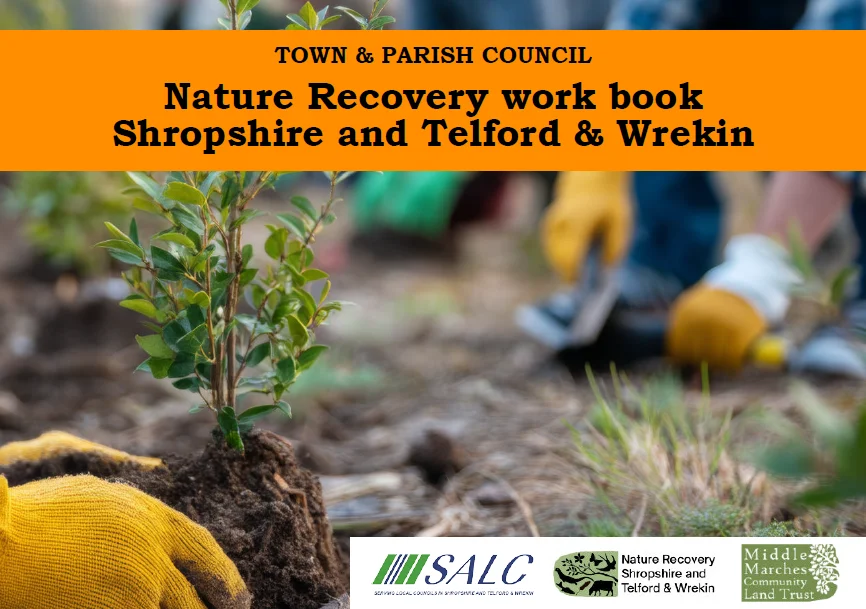
The Nature Recovery workbook has been developed with parish councillors in mind, but anyone can use it. The intention is to help ordinary people do something for nature recovery in the belief that many small actions add up to a big outcome. There are editable areas where you can add your own progress (make sure you save the pdf to keep your changes!). You can access the workbook by clicking on the image.
This guide for town & parish councils provides further information.
Community groups
There are lots of community groups working to help the nature in their area: community wildlife groups, Wildlife Trust local branches, Telford Green Spaces Partnership and many more. Organisations and individuals are involved in a range of activities – surveying, practical work parties, running events and delivering local projects.
- Citizen science and monitoring: encourage residents to participate in species monitoring and habitat surveys. This helps build local data and awareness and supports evidence-based decision making
- Volunteering and stewardship: support and join local restoration projects such as planting native species, reducing pesticide use and creating pollinator-friendly zones in gardens and public spaces
- Education and outreach: organise or attend nature walks, school programmes and public talks to raise awareness of nature and ecosystem services
- Collaboration with local councils and conservation groups: work with others to identify and restore parish-owned land to make it more wildlife friendly. Transform community gardens, school grounds, and allotments into biodiversity hotspots. These areas can serve as stepping stones for wildlife and educational hubs for residents
If you want to enhance the nature in a road verge there are resources and advice on the Restoring Shropshire’s Verges Project (RSVP) website.
This guide for communities provides further information on what the LNRS means for communities interested in taking action for nature.