
The Spatial Strategy
Overview
4.1 A spatial strategy provides the ‘framework’ to achieve the vision and measurable outcomes of a Local Plan.
4.2 To do so, it establishes clear expectations for the amount and distribution of development, whilst also identifying locations that should be conserved or enhanced for specific purposes such as landscape conservation, habitat improvement and containing larger urban areas.
Amount of Development
4.3 The 'starting point' of a spatial strategy is generally the amount of development to be identified in the Local Plan - how much housing and employment should we plan to deliver?
Housing
4.4 The amount of housing planned to be delivered is known as the ‘housing requirement’.
Local Housing Need
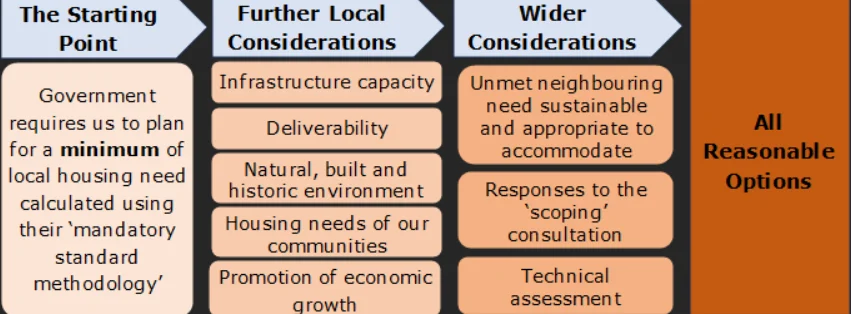
4.5 When preparing options for the ‘housing requirement’ the starting point is local housing need, which Government has made clear is the minimum amount of housing to be planned for – on this we have no choice.
4.6 To assess local housing need, Government have developed a ‘mandatory standard methodology’. This involves consideration of two key datasets:
a/ Existing housing stock – how many existing homes there are.
b/ The housing affordability ratio – how ‘affordable’ is existing housing.
4.7 Using this methodology, we have calculated that in Shropshire (at 31st March 2026) there is an annual local housing need of 2,030 dwellings, equating to 40,600 dwellings over the 20-year period to 2046.
4.8 This calculation is summarised in our Local Housing Need Assessment on our evidence base page.
4.9 Every year, Government updates the two key datasets that inform the mandatory standard methodology. Whilst it's understood that there's no specific requirement for evidence to be updated during the plan-making process, these changes will be kept under review.
Local Considerations
4.10 We consider there are a number of other relevant local considerations when preparing options for the ‘housing requirement’ for Shropshire. These are:
a/ Infrastructure capacity: Ensuring sufficient infrastructure capacity to support existing and new communities.
b/ Deliverability: Reflecting capacity in the market, particularly as local housing need is much higher than both that calculated using previous methodologies and planned for in the adopted Local Plan (an annual average of 1,375 dwellings).
c/ Natural, built and historic environment: Conserving and enhancing the assets that make Shropshire unique.
d/ Housing needs of groups in our communities: Seeking to meet the needs of groups in our communities – recognising the critical role of affordable and specialist housing in doing so.
e/ Economic growth: Recognising the role new housing plays in attracting working age people into the county to support economic growth, providing further employment opportunities for our communities.
Other Considerations
4.11 National policy requires that we consider whether any unmet housing needs are arising in neighbouring areas that would be appropriate and sustainable to accommodate in Shropshire.
4.12 We are committed to undertaking effective co-operation with neighbouring Local Planning Authorities during the plan-making process. However, due to the significant changes that have occurred to the plan-making process and national policy we do not consider that it can currently be determined if unmet housing needs are likely to arise in neighbouring areas and if they do, whether it would be sustainable and appropriate to accommodate them in Shropshire.
Consultation and Technical Assessment
4.13 The preparation of reasonable options and subsequent identification of the preferred option for the ‘housing requirement’ will be informed by responses to this ‘scoping’ consultation and various technical assessments.
Summary
4.14 Figure 4.1 summarises the various factors we consider should inform the preparation of options for the 'housing requirement' for Shropshire. If you'd like the information provided in an alternative format, please let us know.
Figure 4.1: Considerations – ‘Housing Requirement’ Options
Question 9
Do you agree with the considerations we have identified to inform preparation of the housing requirement for Shropshire? Please explain your answer, particularly if you disagree with any of the identified considerations.
Question 10
Are there any other considerations you believe should inform the preparation of the housing requirement for Shropshire? Please explain your answer.
Employment
4.15 The amount of employment land to be made available for economic development is known as the ‘employment land requirement’.
4.16 The Local Plan must ensure that the scale of the ‘employment land requirement’ will meet Shropshire’s ‘local employment land needs’ arising from local business growth and inward investment into Shropshire.
Local Employment Land Needs
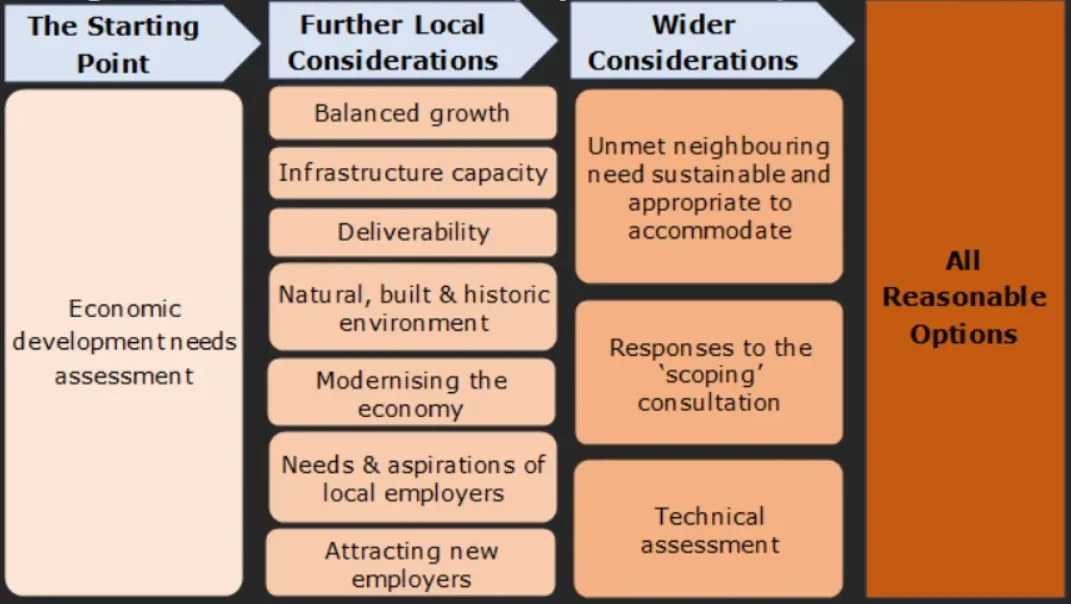
4.17 When preparing options for the ‘employment land requirement’, the starting point is to understand the demands and opportunities for economic growth in Shropshire. This will be achieved through an Economic Development Needs Assessment which will describe the County’s ‘local employment land needs’ and recommend ‘reasonable options’ for the ‘employment land requirement’.
4.18 Although there is a standard method for assessing housing need, there is no nationally prescribed approach for assessing ‘local employment land need’. The methodology used to assess the County’s ‘local employment land need’ will therefore reflect national guidance and best practice for assessing local business growth, inward investment and the future growth of the local economy in Shropshire.
4.19 To ensure the amounts of housing and employment development to be planned for in the spatial strategy will be in balance, the assessment of the future ‘local employment land need’ will consider the alignment between jobs growth from economic investment and the growth in labour from meeting the housing needs of the County.
4.20 This seeks to ensure that businesses and investors in Shropshire will be able to employ people who live in the County and that new households including some existing Shropshire residents, will have the opportunity to live and to work in the County.
Local Considerations
4.21 We believe there are other relevant local considerations when preparing options for the 'employment land requirement' for Shropshire. These are:
a/ Balanced growth: ensuring that housing and employment growth are balanced and complementary
b/ Infrastructure capacity: ensuring sufficient infrastructure capacity to support existing and new businesses and their employees
c/ Deliverability: reflecting capacity and demand in the market
d/ Natural, built and historic environment: conserving and enhancing the assets that make Shropshire unique
e/ Needs and aspirations of local employers in existing sectors: supporting growth of valued local businesses and associated employment opportunities
f/ Attracting new employers into existing sectors and investment into new sectors: complementing and diversifying the businesses and employment opportunities in Shropshire
g/ Modernising Shropshire’s local economy: meeting the needs of investors in Shropshire for good quality, accessible investment locations, and modern business premises providing contemporary business services and infrastructure with opportunities to access ‘new’ technologies.
Other Considerations
4.22 National policy requires that we consider whether any unmet employment land needs are arising in neighbouring areas and also whether it would be appropriate and sustainable to accommodate these ‘unmet’ needs in Shropshire.
4.23 We are committed to undertaking effective co-operation with neighbouring Local Planning Authorities during the plan-making process. However, significant changes are now being implemented in both the plan-making process and in national policy. This makes it difficult to determine whether unmet employment land needs will arise in neighbouring areas and also whether it is appropriate and sustainable to accommodate any ‘unmet’ needs in Shropshire.
Consultation and Technical Assessment
4.24 The preparation of ‘reasonable options’ and the subsequent identification of the preferred option for the ‘employment land requirement’ will be informed by responses to this ‘scoping’ consultation and various technical assessments.
Summary
4.25 Figure 4.2 seeks to summarise the various factors that we consider should inform the preparation of 'reasonable options' for the 'employment land requirement' for Shropshire. If you'd like the information provided in an alternative format, please let us know.
Figure 4.2: Considerations – ‘Employment Land Requirement’ Options
Question 11
Do you agree with the considerations we have identified to inform preparation of the employment land requirement for Shropshire? Please explain your answer, particularly if you disagree with any of the identified considerations.
Question 12
Are there any other considerations you believe should inform the preparation of options for the employment land requirement for Shropshire? Please explain your answer.
Next Steps
4.26 Figure 4.3 summarises the subsequent process we intend to follow to initially identify and then finalise the preferred options for the ‘housing requirement’ and ‘employment land requirement’ for Shropshire:
Figure 4.3: Preferred Options – Housing and Employment Land Requirements
- Further Technical Assessment
- Identification of Preferred Option
- Further Consultation
- Finalisation of Preferred Option
Distribution of Development
4.27 In Shropshire, we consider that central to our spatial strategy will be the approach to the distribution of development – deciding where new development should occur.
4.28 This is because of our geography. Shropshire is large, diverse and predominantly rural and it contains hundreds of communities (including towns, villages, hamlets and other named locations consisting of scattered groups of houses) which are themselves varied in size, function, character and identity.
Key Principles
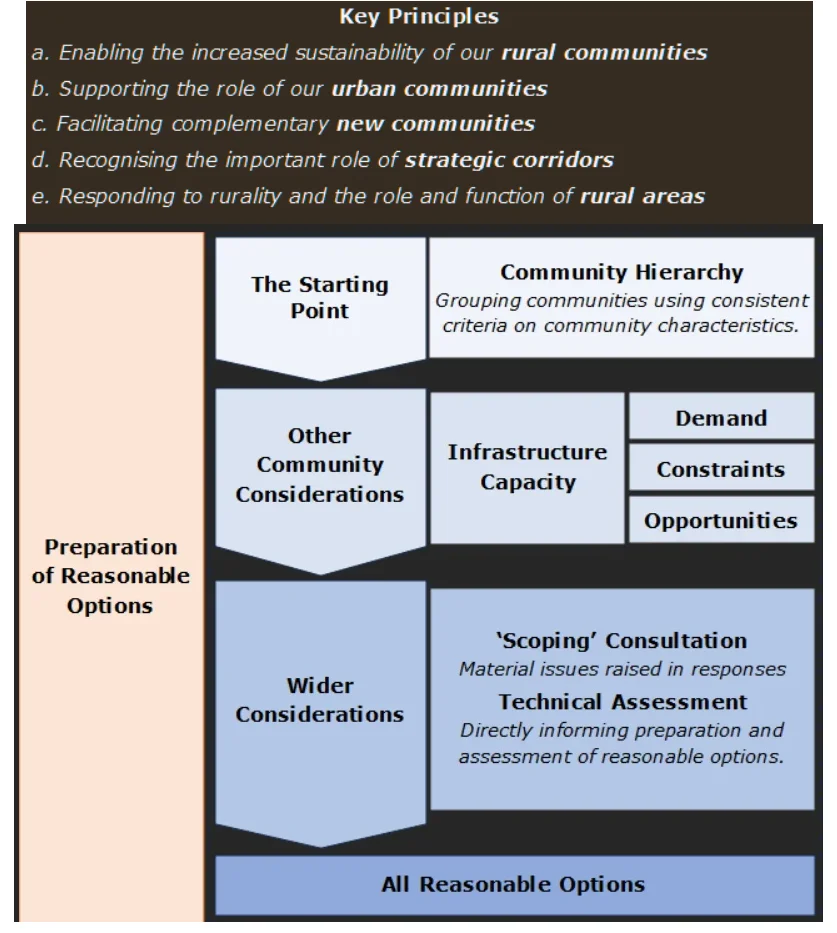
4.29 Reflecting the diversity of Shropshire and our communities, we consider the following 'key principles' should underpin our options for the distribution of development:
a/ Enable our rural communities to become more sustainable and thrive, particularly those that offer their residents and businesses good connectivity to services and facilities.
b/ Support the continued role of our urban communities as centres for services, facilities and economic development that serve both their residents and businesses and those of their rural hinterlands.
c/ Facilitate appropriate and complementary new communities which enhance the sustainability of Shropshire.
d/ Recognise the important role of our strategic corridors – the key road and rail links supporting connectivity.
e/ Respond to the wider rurality of our County, including enabling appropriate development in the countryside.
Question 13
Do you agree with these 'key principles' for the approach to the distribution of development in Shropshire? Please explain your answer, particularly if you disagree.
Preparing Options for the Distribution of Development
4.30 To prepare options for the distribution of development that are responsive to our proposed 'key principles', we believe they should be informed by the consideration of our communities and their attributes:
a/ Community characteristics: including the size of the community and the ability of residents and businesses to access services and facilities.
b/ Infrastructure capacity: existing infrastructure capacity and the ability to enhance capacity to support existing and new residents and businesses.
c/ Demand: understanding of demand for properties.
d/ Constraints: factors that have implications for development capacity, including material planning matters, such as physical features and the historic and natural environment.
e/ Opportunities: factors that can support and enhance development capacity, including complementary investment activities, opportunities to support continued/enhanced infrastructure provision, economic opportunities, access to strategic corridors, availability of brownfield land and unique or significant development opportunities.
Community Characteristics
4.31 We consider the characteristics of our communities is the logical ‘starting point’ when developing options for the distribution of development. This is because characteristics such as size and access to services and facilities influence the role of our communities and their ability to sustainably support new development.
4.32 Consideration of the characteristics of communities is best achieved through the preparation of a Community Hierarchy, which uses specific and consistent criteria on community characteristics to group them based on their similarities.
4.33 As such, we have developed a draft methodology for a Shropshire Community Hierarchy which considers community size and connectivity – utilising data that is nationally endorsed but also responsive to and appropriate in a Shropshire context.
4.34 This draft methodology and the draft conclusions of its application are summarised in the draft Shropshire Community Hierarchy Document which supports this scoping consultation, and is available on the Council website.
4.35 Crucially, whilst we consider the characteristics of our communities the logical ‘starting point’ we recognise there are a number of other important attributes such as infrastructure capacity, demand, constraints and opportunities that must inform options for the distribution of development in Shropshire.
Question 14
Do you agree that the characteristics of our communities form an appropriate ‘starting point’ when determining the distribution of development in Shropshire? Please explain your answer.
Question 15
Do you agree with the methodology and conclusions outlined in the draft Shropshire Community Hierarchy? Please explain your answer, particularly if you disagree with the methodology and/or conclusions of the draft Shropshire Community Hierarchy.
Infrastructure Capacity
4.36 Sustainable development meets the needs of our existing and new residents and businesses - including the need to access necessary infrastructure. Furthermore, we recognise that the capacity of infrastructure is often a concern to communities when faced with new development.
4.37 For this reason, we consider that the existing infrastructure capacity of our communities and the ability to sustainably enhance infrastructure capacity should inform the preparation of options for the distribution of development in Shropshire. This would be achieved through proactive ‘discussions’ with key infrastructure providers.
4.38 Complementary to this consideration when preparing options for the distribution of development, it is expected that infrastructure capacity will also inform the wider plan-making process. Infrastructure capacity will inform the identification of proposed allocations and the site guidelines which will manage their development. It will also inform the preparation of policies detailing when ‘developer contributions’ are required from development, and how such contributions will be prioritised to support infrastructure provision.
4.39 This will be achieved through continued 'discussions' with key infrastructure providers and the preparation of an Infrastructure Delivery Plan to identify the infrastructure considered necessary to support new planned growth and the approach to its funding and delivery.
4.40 We will also use the consultations that form part of the plan-making process to seek views on the infrastructure required to support the achievement of the next Shropshire Local Plan.
Demand
4.41 The demand for properties within our communities is a valuable indicator of those that would most benefit from additional growth to meet the needs of residents and support businesses. Therefore, we consider that property demand is a positive consideration when preparing options for the distribution of development in Shropshire.
4.42 One effective assessment of property demand is that undertaken by the University of Warwick, which utilises 'Rightmove data' to determine 'housing gaps' and ‘tightness ratios’. Their overarching report and conclusions for Shropshire are available on our evidence base page.
4.43 Other sources of evidence on property demand include:
a/ The Council’s HomePoint housing waiting lists.
b/ The Strategic Housing Market Assessment to be prepared to inform the next Shropshire Local Plan - assessing the size, type and tenure of housing needed by different groups in our communities.
c/ Local housing need surveys undertaken over the last 5 years.
d/ The Economic Development Needs Assessment to be prepared to inform the next Shropshire Local Plan - assessing the employment needs of our communities.
Constraints
4.44 Due to Shropshire’s diverse geography, there are a range of different factors that have the potential to constrain development. Such factors are generally not ‘negatives’ often relating to the physical features or historic / natural environment assets that help make our communities unique.
4.45 Where such constraints exist, they generally effect specific parts of a community rather than the community as a whole. As such, they can be managed through appropriate site selection, effective design and layout of development and/or delivery of appropriate mitigation.
4.46 However, there are some instances where these factors can constrain the development potential of a whole community – a good example is where communities are located within the Shropshire Hills National Landscape, which as a treasured landscape requires a more considered approach to development.
4.47 As a result, we feel that constraining factors should be considered when preparing options for the distribution of development in Shropshire. To do so, we intend to:
a/ Identify factors that have the potential to constrain development in Shropshire as part of a ‘baselining’ process
b/ Give consideration to these factors to determine whether any reduce a communities development capacity.
4.48 The process will be informed by engagement with relevant statutory consultees (such as Historic England, the Environment Agency and Natural England) and specialist input from relevant Council services (such as our Ecologists and Historic Environment Officers).
4.49 For the avoidance of doubt, consideration of constraining factors will also inform the identification of proposed allocations and the site guidelines which will inform their development.
Opportunities
4.50 We believe there are many opportunities unique to Shropshire and that the preparation of options for the distribution of development within it should be responsive to them. Those opportunities we have already identified include:
a/ Strategic corridors*: key rail and road routes within Shropshire which support connectivity within the county and provide links to the wider West Midlands and beyond. They support the connectivity of our communities to employment, services and infrastructure, and create opportunities for sustainable growth and investment. The strategic corridor with greatest potential to support sustainable growth is undoubtedly that formed by the A5/M54 and Shrewsbury-Birmingham railway line, linking Shrewsbury-Telford-Wolverhampton.
*Further information on the strategic corridors in Shropshire is provided in Appendix 2 of this consultation documentation.
b/ Supporting rural services: proud to be rural, sustainable growth within our rural communities can provide opportunities to support the continued provision of valued rural services.
c/ Supporting economic growth: our communities, particularly the larger communities, provide the logical focus for economic development and business growth and investment.
d/ Wider Council strategies: opportunities for sustainable growth arising from wider Council strategies or for sustainable growth to facilitate the delivery of wider Council strategies
e/ Shrewsbury parkway station: a key aspiration of ‘Shrewsbury Moves’ is a parkway station outside the town to complement existing rail services in the town centre. Feasibility work has been progressed for this project which presents opportunities for complementary sustainable growth
f/ Capitalising on infrastructure: locations with ‘headroom’ in existing infrastructure or where significant infrastructure investment is planned may present opportunities for sustainable growth.
g/ Potential for new settlements: any strategically located sites of a sufficient scale to create new self-contained communities, complementary to our existing communities. They would offer a mix of housing, employment, infrastructure (including schools, health services and transport networks), services (retail and community facilities) and green space.
4.51 Further opportunities that may be identified relate to complementary investment activities, availability of brownfield land, unique development proposals and specific sites with potential to form new settlements.
4.52 To identify further opportunities, we intend to:
a/ Identify development opportunities in Shropshire as part of a ‘baselining’ process.
b/ Give consideration to these factors to determine whether they increase an existing community’s development capacity or establish the potential for new communities.
4.53 The process will be informed by proactive discussions with key infrastructure providers.
Question 16
Do you agree that the infrastructure capacity, demand, constraints and opportunities associated with our communities should form an important consideration when determining the distribution of development in Shropshire? Please explain your answers, particularly if you disagree.
Question 17
Are there any additional matters we should consider when determining the distribution of development in Shropshire? Please explain your answer.
Consultation and Technical Assessment
4.54 In addition, the preparation of the next Shropshire Local Plan, including reasonable options for the distribution of development and the subsequent identification of the preferred option for the distribution of development, will be informed by technical assessments including SEA, HRA and ESHIA.
Summary
4.55 Figure 4.4 summarises the considerations we believe should inform the preparation of options for the distribution of development in Shropshire. If you'd like the information provided in an alternative format, please let us know.
Figure 4.4: Key Considerations - Distribution of Development Options
Next Steps
4.56 Figure 4.5 summarises the subsequent process we intend to follow to initially identify and then finalise the preferred options for the distribution of development:
Figure 4.5: Preferred Distribution of Development Option
- Further Technical Assessment
- Identification of Preferred Option
- Further Consultation
- Finalisation of Preferred Option
Areas and Assets to be Conserved or Enhanced
4.57 Within our spatial strategy, complementary to decisions on the amount and distribution of development is the identification of locations that should be conserved or enhanced.
4.58 In Shropshire, we are very fortunate to have a rich and diverse built, natural and historic environment. As such, consistent with national policy, we consider it is important that our spatial strategy identifies and supports the conservation and enhancement of our:
a/ Designated historic environment assets in Shropshire, including:
i/ Two world heritage sites (which are cross-border)
ii/ Registered battlefield
iii/ 34 registered historic parks or gardens (3 are cross-border)
iv/ 128 conservation areas.
v/ Around 440 scheduled monuments
vi/ Around 7,000 listed buildings
b/ Designated natural environment assets in Shropshire, including:
i/ The Shropshire Hills National Landscape (around 23% of Shropshire)
ii/ 6 special areas of conservation (cross-border assets)
iii/ 2 phases of Ramsar sites (cross-border assets)
iv/ 4 national and 33 local nature reserves
v/ 111 sites of special scientific interest
vi/ Ancient woodland (around 2% of Shropshire)
vii/ 1000's of veteran trees and trees subject to preservation orders
4.59 Further, we have a wealth of non-statutory non-designated heritage assets and significant archaeological potential. We consider these assets should be recognised and given proportionate consideration within our spatial strategy.
Question 18
Do you agree our spatial strategy should ensure proportionate consideration is given to non-designated heritage assets and areas of archaeological potential? Please explain your answer.
4.60 To support nature recovery in Shropshire, we have prepared a Local Nature Recovery Strategy. This identifies where action for nature can provide the greatest benefit for biodiversity and the wider environment (known as potential areas of particular importance for biodiversity).
4.61 We consider that our spatial strategy provides an important opportunity to maximise the potential of these ‘action areas’.
Question 19
Do you agree our spatial strategy should support achievement of the Local Nature Recovery Strategy - maximising the potential of the locations identified where action can provide the greatest benefit for biodiversity and the wider environment? Please explain your answer.
Question 20
Are there any other areas or assets you believe should be identified for conservation or enhancement within our spatial strategy? Please explain your answer.